
.png)
.png)
Science. Art. Film.: Spirits of the Air, Gremlins of the Clouds
Wed
18
Wed 18 Mar 6:00 PM
Arc Cinema
Allocated Seating
March
1987 | DCP | AUS | D: Alex Proyas
Japanese, English subtitles
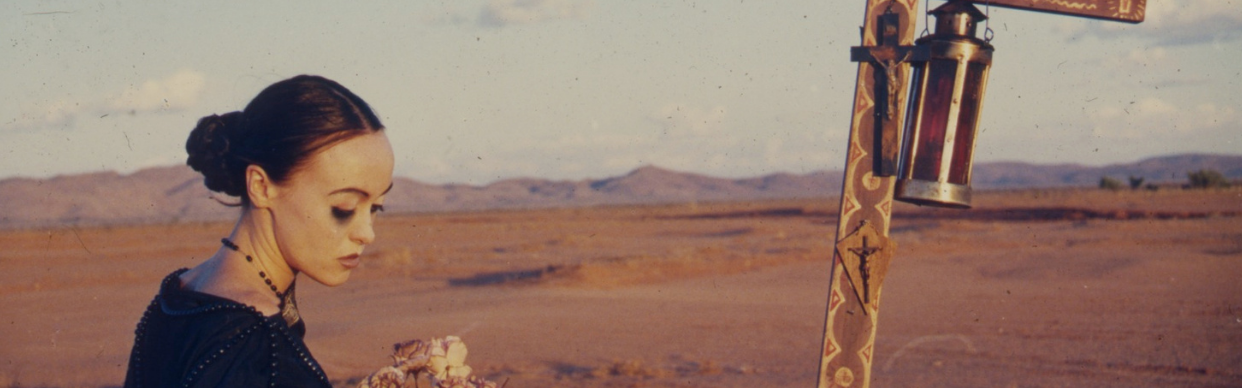
In a post-apocalyptic world siblings Felix and Betty Crabtree live alone in a homestead on a treeless desert plain. Their fragile equilibrium is disrupted when Smith – a fugitive with a mysterious past, arrives.
Shot on location in Broken Hill, this haunting science fiction adventure film was the debut feature for Alex Proyas. It is an early showcase of his distinctive cinematic vision. With minimal dialogue Spirits of the Air, Gremlins of the Clouds unfolds as a poetic meditation on loneliness, grief and longing. The film has a dreamlike tone and is praised by David Stratton for its “brilliant production design.”
‘A rigorously imagined work in which landscape, silence and fantasy merge, Spirits of the Air stands apart from Australian realism, offering instead a fragile, visionary cinema of loss.’ - Meaghan Morris, Continuum: Journal of Media & Cultural Studies
Join us after the film for a lively conversation with a fashion and culture scholar and a biologist who studies sand. Discover the unexpected connections between Australian desert fantasies and pop culture, as well as why they’re fascinating to study and understand!
Panellists:
Dr Hawthorn King received his PhD in Social Sciences from UNSW. He publishes on the intersections between wit, fashion and glamour. Dr King describes wit in Western philosophy as humour that produces surprise and delight by offering an unexpected and creative insight that entertains and provokes thought. Wit, in short, makes the world anew. Fashion, with its sudden and strange apparitions, can also produce the sudden and unexpected insights to be found in wit. Hawthorn’s current research focuses on Australian social history, and the playful ways men have developed their own postcolonial fashion identities. The wit of these sartorial subcultures belies the perception of Australia as a masculine fashion terre des ruines.
Dr Mitzy Pepper is an evolutionary biologist obsessed with lizards and deserts. Australia has an extraordinary number of lizard species, and the highest diversity is found in the deserts of Western Australia. But our lizards are old in an evolutionary sense, whereas our deserts are surprisingly young, so these amazing animals have had to endure some pretty crazy climatic changes to arrive at the species diversity we see today. Mitzy has spent the last 20 years trying to understand how geology and climate and environmental change have written themselves into lizard genomes - leaving clues we can read today about survival, movement, and the making of new species.
Moderator:
Dr Anna-Sophie Jürgens is a Senior Lecturer in Science Communication at the Australian National Centre for the Public Awareness of Science, ANU and the Head of POPSICULE, ANU’s Science in Popular Culture and Entertainment Hub. Dr Jürgens’ research explores cultural meanings of science, the history of (violent) clowns and mad scientists, science and humour, and the interface between science and (public) art.
Presented as part of our Science. Art. Film. series in partnership with the Australian National Centre for the Public Awareness of Science, ANU.
Japanese, English subtitles
In a post-apocalyptic world siblings Felix and Betty Crabtree live alone in a homestead on a treeless desert plain. Their fragile equilibrium is disrupted when Smith – a fugitive with a mysterious past, arrives.
Shot on location in Broken Hill, this haunting science fiction adventure film was the debut feature for Alex Proyas. It is an early showcase of his distinctive cinematic vision. With minimal dialogue Spirits of the Air, Gremlins of the Clouds unfolds as a poetic meditation on loneliness, grief and longing. The film has a dreamlike tone and is praised by David Stratton for its “brilliant production design.”
‘A rigorously imagined work in which landscape, silence and fantasy merge, Spirits of the Air stands apart from Australian realism, offering instead a fragile, visionary cinema of loss.’ - Meaghan Morris, Continuum: Journal of Media & Cultural Studies
Join us after the film for a lively conversation with a fashion and culture scholar and a biologist who studies sand. Discover the unexpected connections between Australian desert fantasies and pop culture, as well as why they’re fascinating to study and understand!
Panellists:
Dr Hawthorn King received his PhD in Social Sciences from UNSW. He publishes on the intersections between wit, fashion and glamour. Dr King describes wit in Western philosophy as humour that produces surprise and delight by offering an unexpected and creative insight that entertains and provokes thought. Wit, in short, makes the world anew. Fashion, with its sudden and strange apparitions, can also produce the sudden and unexpected insights to be found in wit. Hawthorn’s current research focuses on Australian social history, and the playful ways men have developed their own postcolonial fashion identities. The wit of these sartorial subcultures belies the perception of Australia as a masculine fashion terre des ruines.
Dr Mitzy Pepper is an evolutionary biologist obsessed with lizards and deserts. Australia has an extraordinary number of lizard species, and the highest diversity is found in the deserts of Western Australia. But our lizards are old in an evolutionary sense, whereas our deserts are surprisingly young, so these amazing animals have had to endure some pretty crazy climatic changes to arrive at the species diversity we see today. Mitzy has spent the last 20 years trying to understand how geology and climate and environmental change have written themselves into lizard genomes - leaving clues we can read today about survival, movement, and the making of new species.
Moderator:
Dr Anna-Sophie Jürgens is a Senior Lecturer in Science Communication at the Australian National Centre for the Public Awareness of Science, ANU and the Head of POPSICULE, ANU’s Science in Popular Culture and Entertainment Hub. Dr Jürgens’ research explores cultural meanings of science, the history of (violent) clowns and mad scientists, science and humour, and the interface between science and (public) art.
Presented as part of our Science. Art. Film. series in partnership with the Australian National Centre for the Public Awareness of Science, ANU.
March